

Why Execution Intelligence Is the Missing Layer in Enterprise AI
Enterprise leaders have raced to experiment with artificial intelligence.
Large language models.
AI copilots.
Autonomous agents.
Across financial services, life sciences, manufacturing, and other industries, organizations have invested billions of dollars in AI initiatives.
But as we move into the next phase of enterprise adoption, a clear shift is emerging.
Enterprises are no longer asking “Can we build AI?”
They are now asking:
“How do we operationalize AI across the enterprise and prove the ROI?”
And this is where many organizations are discovering a critical gap.
The Real Challenge Isn’t AI — It’s Understanding Work
Most AI discussions focus on models, infrastructure, and training data.
But in enterprise environments, the real challenge lies somewhere else entirely.
It lies in understanding how work is actually performed.
In most organizations, critical business processes span:
- Enterprise applications like Pega, Salesforce, SAP, Guidewire, Veeva
- Internal workflow systems
- Homegrown applications
- Spreadsheets
- Manual data entry
- Cross-system navigation
The result is what many organizations experience daily:
The human execution layer of work.
Employees navigating systems.
Looking up information.
Re-entering data.
Working around system limitations.
Making decisions based on context.
Yet most enterprise data platforms capture only system logs and process events, leaving the human execution layer invisible.
Without visibility into this layer, enterprises face three major problems when deploying AI.
Three Barriers to Operationalizing Enterprise AI
1. AI Agents Are Built Without Understanding Real Workflows
Many AI initiatives attempt to automate workflows that are poorly understood.
System logs tell part of the story.
But they rarely capture:
- Cross-system work
- Manual steps
- Rework loops
- Decision patterns
- Exceptions
As a result, AI agents are often built on assumed workflows rather than real execution patterns.
The outcome:
Automation that doesn’t reflect how work actually gets done.
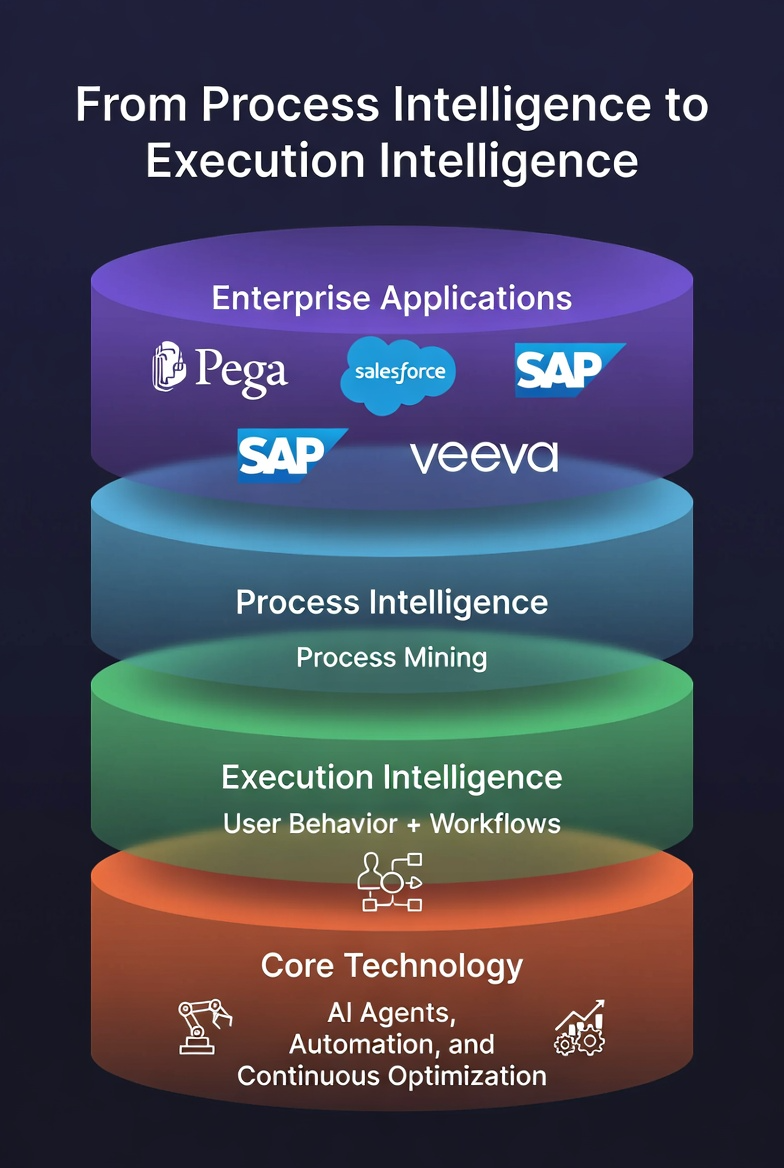
Title: The Missing Layer Between Processes and AI
2. Enterprises Lack a Baseline for Workforce Productivity
Before AI can improve productivity, organizations must answer a fundamental question:
What is current productivity?
In many enterprises, productivity is measured using indirect metrics:
- Case throughput
- Average handling time
- SLA adherence
But these metrics rarely reveal:
- Time lost navigating systems
- Rework caused by poor UX
- Manual effort across applications
- Process fragmentation
Without this baseline, it becomes difficult to determine where automation or AI will generate the greatest impact.
3. AI ROI Is Difficult to Measure
Even when AI agents are deployed successfully, many organizations struggle to answer the most important question:
Did productivity actually improve?
If enterprises cannot measure:
- Time saved
- Reduced friction
- Improved workflow efficiency
- Reduced manual effort
AI investments quickly become difficult to justify.
And that creates the next challenge:
Scaling AI beyond isolated pilots.
The Rise of Execution Intelligence
To solve this gap, a new data layer is emerging inside enterprises.
We call it Execution Intelligence.
Execution Intelligence captures how work actually happens across systems, applications, and employees.
Instead of relying solely on system logs, it observes:
- Screen navigation
- Workflow paths
- Cross-system activity
- Field interactions
- Context switches
- Error patterns
This creates a real-time understanding of the human execution layer inside enterprise processes.
And this data becomes incredibly valuable for AI.
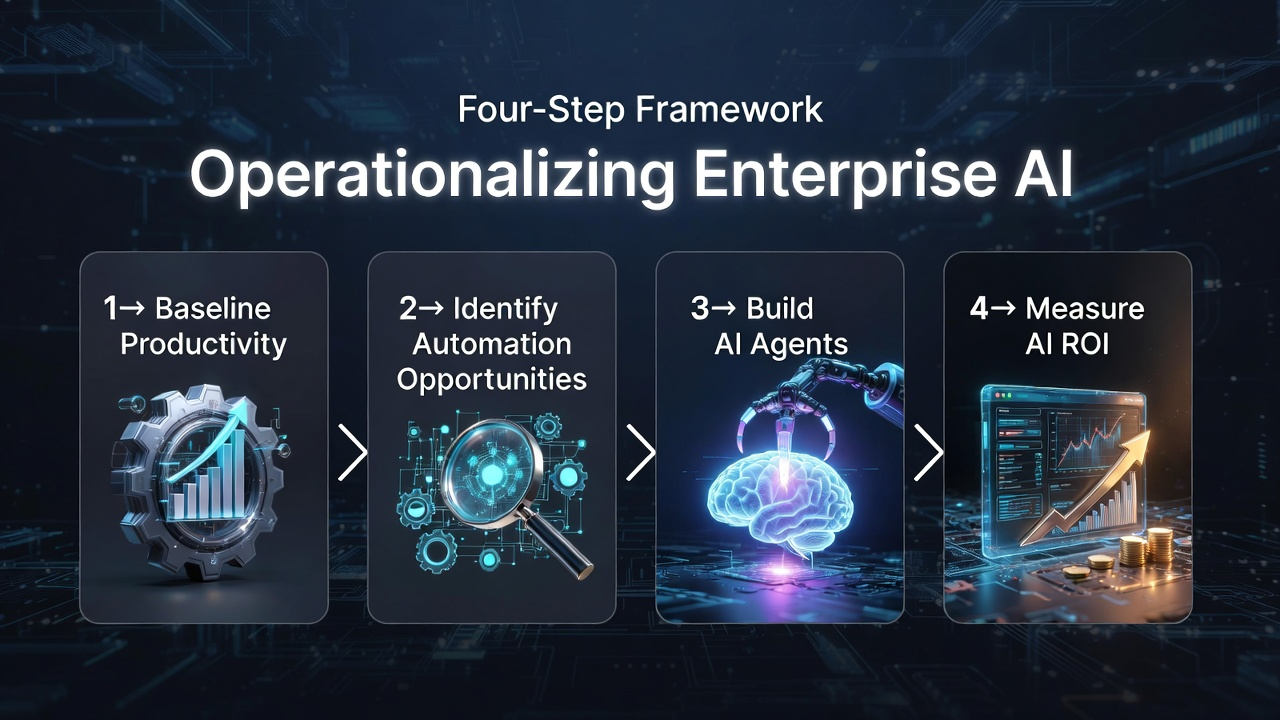
The Four Foundations of Operationalizing AI
Organizations successfully deploying enterprise-scale AI tend to follow a similar progression.
1. Baseline Workforce Productivity
Before introducing automation or AI, organizations must understand:
- Where time is spent
- Where friction occurs
- Where work breaks down
This baseline creates a data-driven starting point for improvement.
2. Identify High-Impact Automation Opportunities
Once execution patterns are understood, organizations can identify:
- Repetitive work
- Cross-system inefficiencies
- Manual tasks
- Workflow bottlenecks
These become the highest-value automation opportunities.
3. Build AI Agents on Real Execution Data
Rather than designing AI agents based on theoretical workflows, organizations can now build agents based on:
- Real decision paths
- Real user behavior
- Real process variants
This dramatically improves automation success rates.
4. Measure AI ROI in Production
Finally, execution intelligence enables enterprises to quantify impact by measuring:
- Time saved
- Reduced friction
- Improved throughput
- Productivity improvements
This transforms AI from experimentation into measurable operational improvement.
Title: Operationalizing Enterprise AI
Why This Matters Now
Enterprise AI is entering a new phase.
The era of experimentation is ending.
Boards, executives, and regulators are increasingly asking:
- What business value is AI delivering?
- How is productivity improving?
- Where are we seeing measurable returns?
Answering these questions requires a new foundation of operational data.
Not just system logs.
Not just models.
But a clear understanding of how work is actually performed across the enterprise.
From AI Hype to Measurable Transformation
The organizations that succeed in the next phase of AI adoption will not necessarily be those with the most advanced models.
They will be the ones with the best understanding of how their operations actually run.
Because AI without execution intelligence is speculation.
But AI built on real operational data becomes something far more powerful.
Measurable transformation.
 Pyze Blog